
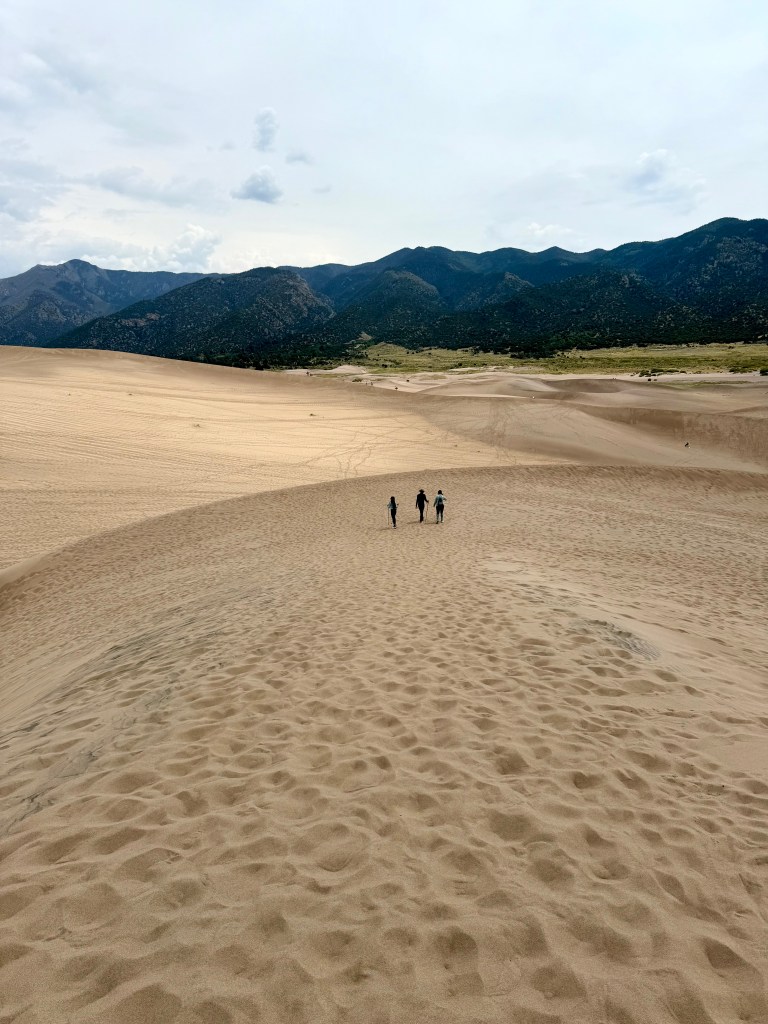
I recently traveled to the Great Sand Dunes National Park in Colorado. Standing at the base of the High Dune, the sheer scale is disorienting—mountains of shifting sand rising 750 feet against the backdrop of the Sangre de Cristo mountain range. Hiking the dunes was an endurance test, a physical reminder that true perspective is usually earned through sweat.
The following day, I visited Zapata Falls, a beautiful babbling creek, where the temperature dropped dramatically inside a sheltered rocky crevasse where an icy waterfall poured down. Despite the freezing water, my family and I hiked through the creek to reach the waterfall where water rushes down a 30 foot drop into the creek we stood in. My toes were soaked through and numb, but the sight was well worth the chill—a startling, icy contrast to the giant sun-scorched dunes just miles away.
Despite the harsh, almost alien landscape, life was surprisingly abundant. Mule deer moved silently through the transition zones and chipmunks darted between pinyon pines. Observing their behavior (e.g., how the deer conserve energy, how the chipmunks foraging so efficiently) you could see the results of a multimillion-year algorithm running in real-time. Places like this remind me that ecosystems are actually complex biological networks of variables that constantly evolve based on interactions with different species and their environment.



 Biosphere Bits